


 Smriti Gupta
 14 Oct-2026
 Recruitment & Hiring
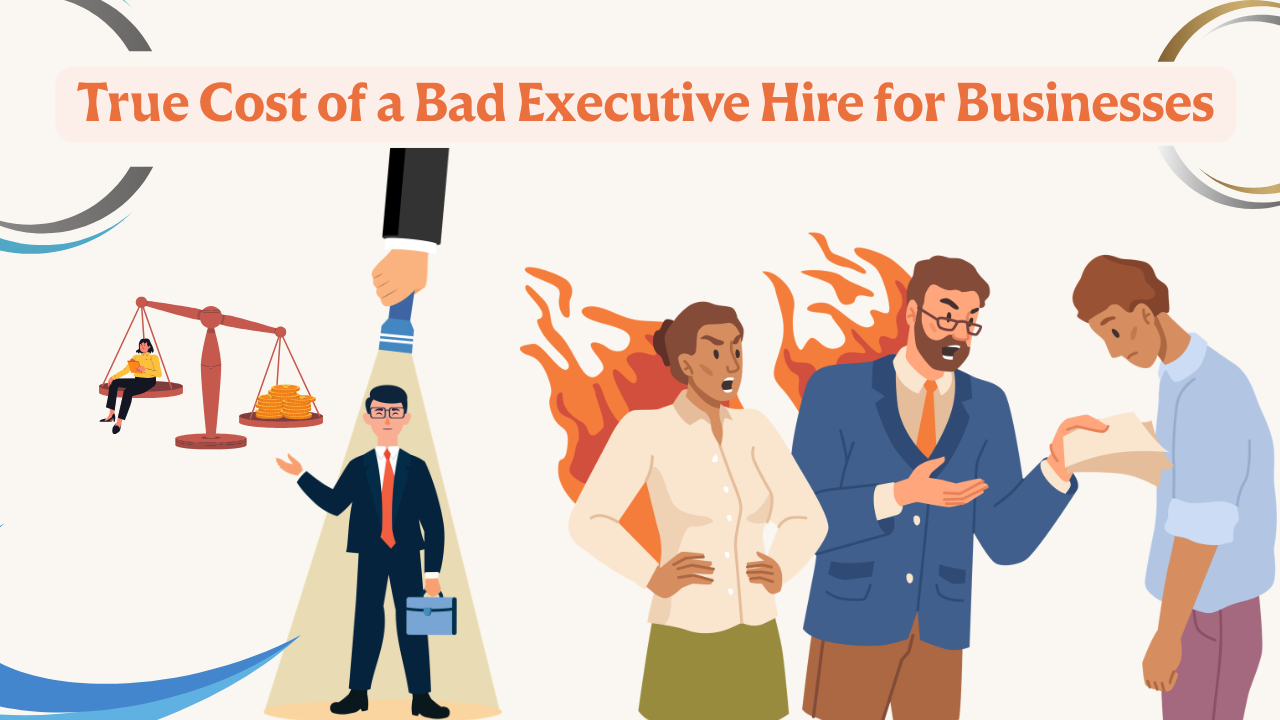
Investing in a senior executive is a big decision for any company. A good leader can help a company grow, motivate staff and achieve long term goals.
A bad executive hire can cost money, delay important projects, hurt employee morale and degrade the company culture. The damage can be a lot worse than a bad performance review. Sometimes, it takes months for companies to fix problems that a better hiring process could have avoided.
Understanding the cost of a bad hire helps companies make smarter recruitment decisions. It also highlights why finding the right leader matters as much as filling the position quickly.
Hiring a senior executive costs a considerable amount. Companies spend money on job ads, recruitment agencies, interviews and background checks and onboarding. And the costs don’t end there.
Many senior leaders get high salaries, bonuses, benefits and other incentives. If the appointment doesn’t work out, the company has paid a lot and not received the value expected.Depending on the employment contract, the business may have to pay notice periods, severance or other exit related costs.
A senior executive is hired by a company to head its division. The executive is well compensated, a few months later the company decided to replace them. Now it has to pay for recruiting, pay salaries, and lose sales opportunities.
Here’s how the cost of a bad hire can quickly become much more than just the executive’s salary.
Executives make decisions that affect the whole organization. They prioritize, oversee budgets, deploy resources, and guide teams to business goals. If the leadership is not up to the task, these activities can go astray.
A poor executive may have a hard time making timely decisions. They might change priorities too often, approve unworkable plans, or not set clear expectations. Teams then spend time fixing errors instead of moving projects forward.
Even the best-laid ideas and concepts can go bad due to poor implementation. The effects can be far-reaching, from dissatisfied customers and partners to loss of competitive advantage, delays, and a deterioration in the quality of services or goods. A chief executive officer’s inadequate leadership can have a negative effect not only on the employees but also on sales, customer satisfaction, product development, and overall productivity.
Therefore, it is essential to recognize that effective leadership involves not only decision-making but also consulting the appropriate personnel, and turning ideas into reality.
One of the most overlooked costs of a poor executive hire is the damage done to company culture.
Workers look to company executives to set the tone, so if a new leader is mean or vindictive, employees can become disillusioned with their workplace.
Loyal, talented employees possess a wealth of knowledge about customers, company processes and procedures, and more. Losing them can be very costly to the company, not only in terms of profits but also in new hires who will need to be trained to fill their shoes.
These employee turnover costs can comprise recruitment, training, and replacement expenses, loss of productivity, and the managerial time spent on filling vacant positions. The combination of several attrition cases triggered off by a single executive can add up to a significant cost.
A positive workplace culture serves continuous communication with workers, empathy, clear expectations, and trust.
Senior employees, provided with years of experience, possess a wealth of knowledge about clients, business processes, and relationships within the firm. Therefore, their departure will entail not only the loss of skilled workers but also the high costs of recruitment, training, and productivity loss during the learning period.
The good news is that every company has the possibility to make its executive appointments less disastrous, and the first useful step is to treat such decisions strategically.
Finally, make sure to analyse failed appointments and learn from them. Most companies make the same mistake of rushing into a new hire without defining exact requirements and then blaming the executive for underperformance once they realise the wrong choice was made. Instead, ask yourself these questions: was the position described clearly enough? Was there any communication gaps between business and candidates?
A wrong executive recruit can damage almost all spheres of a firm’s functioning. Not only finances but also other factors can be negatively affected by a low-quality appointment. These include project delays, missed targets, loss of morale, and increased staff turnover.
Thus, the expense of such a mistake can be enormous as the company’s progress can be halted for a long time. Therefore, it is essential to consider the benefits of senior executive recruiting carefully. The proper evaluation of the candidates and the determination of their expectations from the position will reduce the possibility of failure.
Although it takes a lot of time, choosing the candidate who would benefit the firm will save the company from expensive mistakes and ensure the development of a positive corporate culture. In this way, it becomes apparent that a right executive recruit can become the driving force of the organisation’s progress.